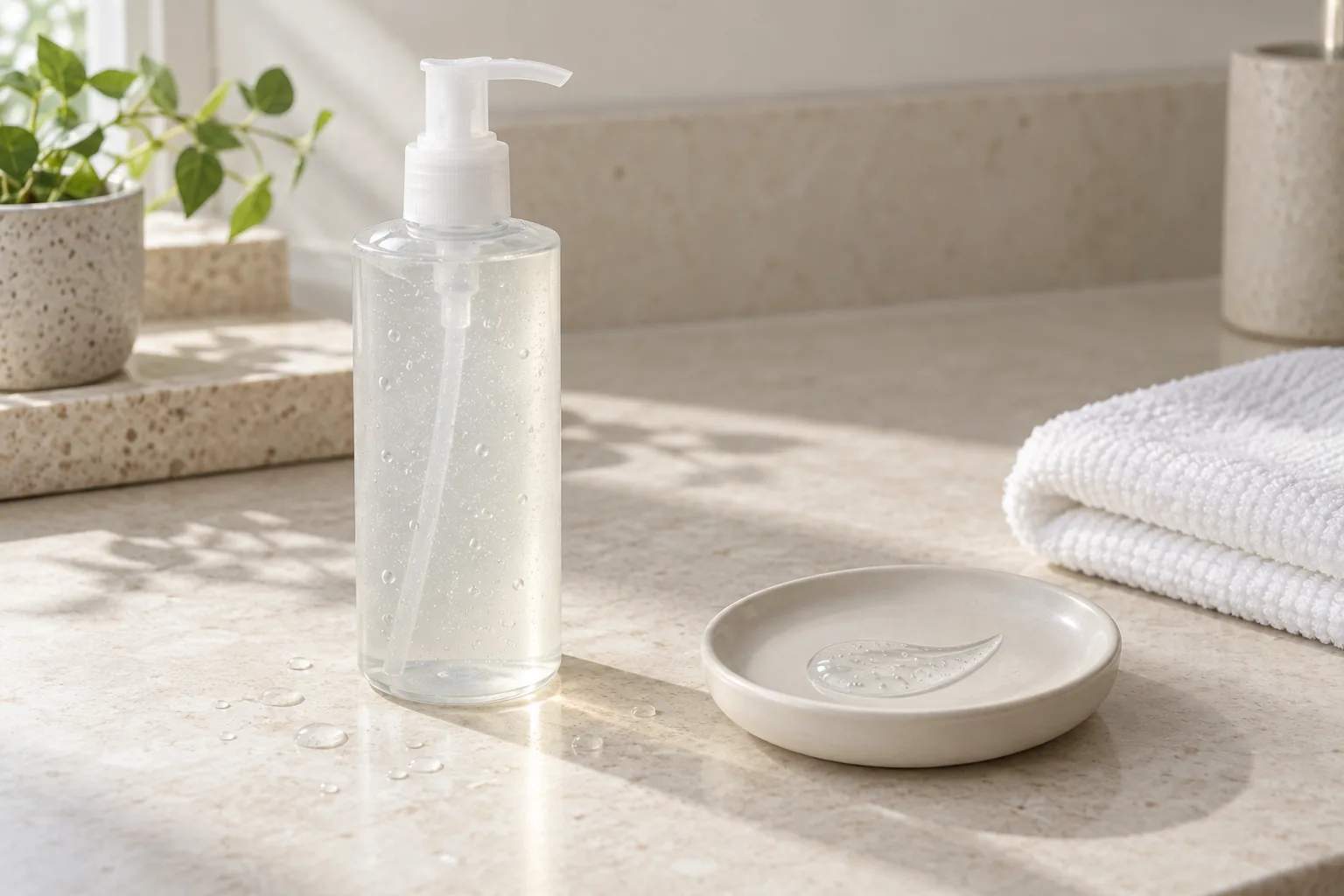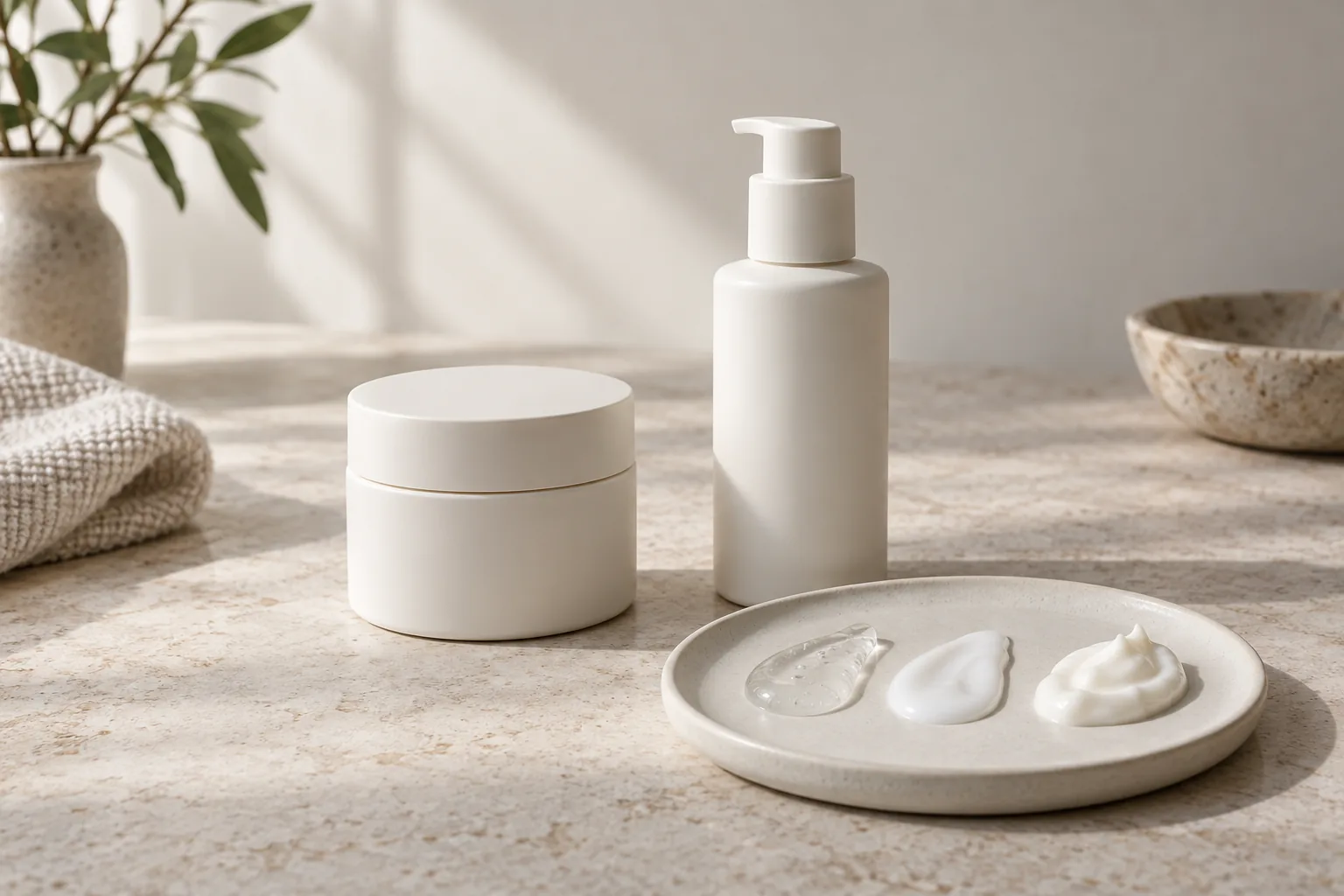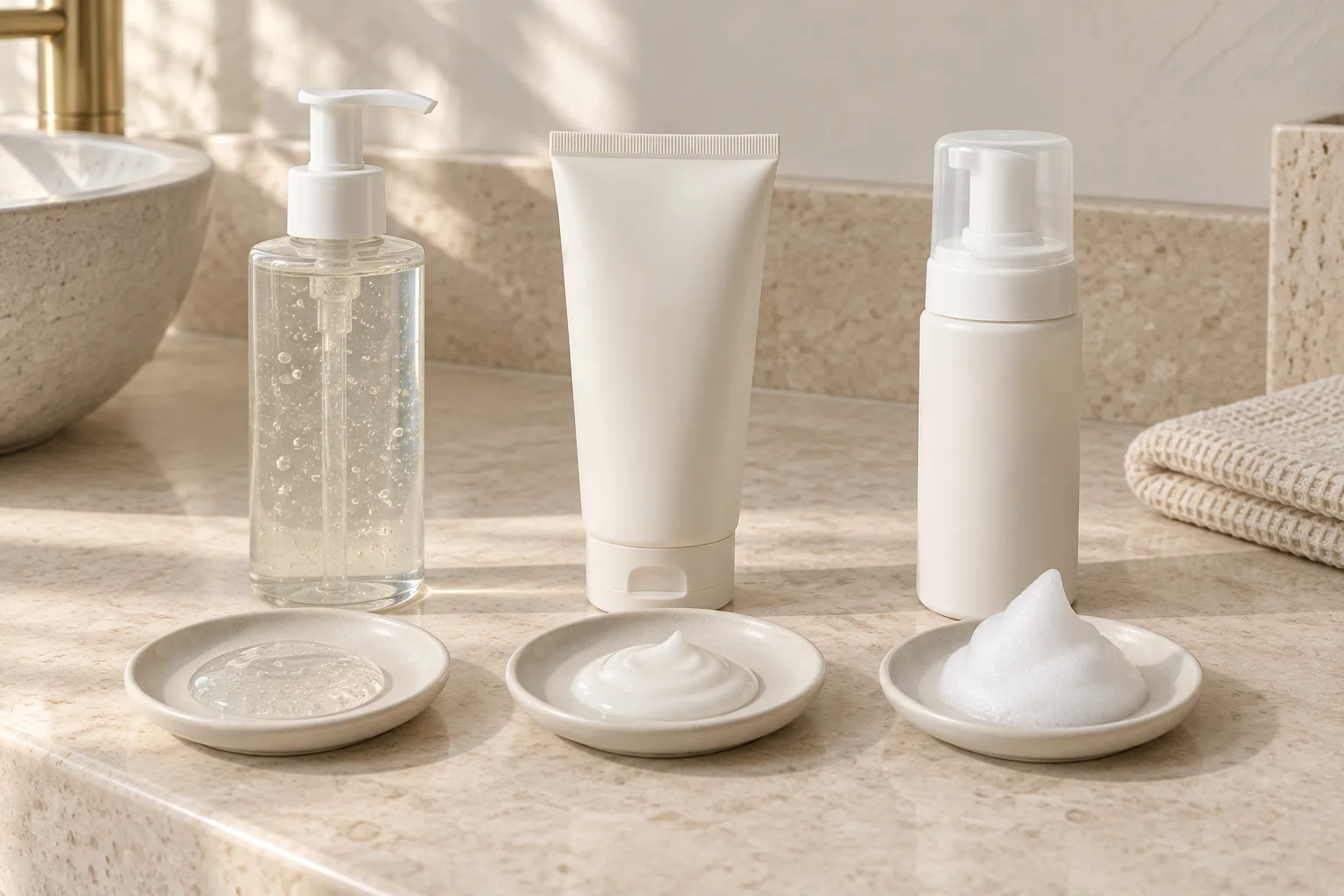
Treat gel, cream, and foam as workflow clues, not a ranking from gentle to harsh. Gel tells you how the product starts and spreads. Cream suggests a richer, more cushioned vehicle. Foam describes what reaches your face—or what forms when water and rubbing add air. None of those names guarantees how much sunscreen the product removes or how comfortable your skin will feel afterward.
The most useful comparison is practical: what is on your face, how you want the cleanser to spread and rinse, and what happens after several normal washes.
The short comparison
| Format | Often useful when | Practical strength | Common mismatch |
|---|---|---|---|
| Gel | You want controlled placement and a clean rinse | Easy to portion; can range from nonfoaming to high-lather | Assuming clear gel is automatically mild or oil-controlling |
| Cream | Dry-feeling skin or a light residue load needs more slip | Cushioned massage and less “squeaky” after-feel in many formulas | Mistaking a conditioned finish for incomplete cleansing |
| Foam | You value quick distribution and easy rinsing | Pre-foamed pumps can reduce the work needed to build lather | Using bubble volume as a measure of cleansing power |
These are tendencies, not standards. The ingredient system and finished formula matter more than the word on the front.
Gel cleansers: a texture with a wide range
A gel holds its shape better than a thin liquid, which can make it easy to place around the nose, hairline, and jaw. But “gel” says little about the surfactant system. One gel may barely lather and leave a conditioned finish; another may build abundant foam and remove oil assertively.
Consider a gel first when you want a measured amount, a fast rinse, or a formula that can handle ordinary sweat and light sunscreen without the richer feel of a cream. Then check the directions. Some gels are meant for wet skin; an oil-gel or makeup-removing gel may start on dry skin. The format name cannot supply missing instructions.
Do not assign every gel to oily or acne-prone skin. Acne is not caused by a failure to produce enough lather, and a medicated acne wash has a separate active ingredient, Drug Facts panel, and use directions. Choose that product for its labeled treatment role, not because the base happens to be gel.
Cream cleansers: cushion with a finish tradeoff
Cream cleansers use an emulsion-like texture that can provide slip and reduce the urge to scrub. They are often a sensible first trial for dry-feeling or easily irritated skin with a light daily residue load. Some dissolve makeup well; others are deliberately mild and may not fully remove a water-resistant film.
The after-feel can be the deciding factor. If the cleanser removes what you need and skin is comfortable, a soft or conditioned finish is not evidence that dirt remains. If you dislike a persistent film, switch rinse profile instead of adding hot water or a rough cloth.
“Cream” is not a safety certificate. A cream cleanser can contain fragrance or another ingredient that does not suit you, and a product can still sting compromised skin. Judge the complete formula and your response.
Foaming cleansers: bubbles change the experience
A foaming cleanser may emerge as foam from a pump, or begin as a gel or cream and lather with water. Foam helps a product distribute visibly, which some people find easier to rinse. Bubble volume, however, does not directly measure how well a sunscreen, makeup film, or excess oil has been removed.
Modern foaming systems vary. Reviews of cleanser formulation describe how surfactant blends, pH, and moisturizing components influence interaction with the outer skin. That is why one foam can feel comfortable while another leaves persistent tightness. The word “foaming” cannot rank them in advance.
Choose foam because its handling makes your routine easier, not because the sensation feels more serious. Use fingertips and lukewarm water; the American Academy of Dermatology advises against abrasive tools and scrubbing.
Hybrid names are a reason to read twice
Cream-to-foam, gel-to-foam, jelly, milk, balm, and oil-to-milk products cross category lines. A cream-to-foam product may offer more cushion than a clear gel, yet rinse more cleanly than a nonfoaming cream. A gel-oil may target adherent makeup rather than ordinary morning cleansing.
When a product has two format words, separate three questions:
- What texture leaves the package?
- Does it need dry skin, wet skin, or added water?
- What residue is it labeled to remove?
Those answers predict use better than placing the bottle on a rigid “dry skin versus oily skin” chart.
Match four common jobs
A low-residue morning wash: A mild cream, low-lather gel, or water alone may be enough, depending on comfort and any prescribed routine. A pre-foamed product can also work; there is no need to avoid foam by rule.
Ordinary end-of-day sunscreen and sweat: Start with a rinse-off gel or foam whose directions match face cleansing. If it removes the layer without lasting tightness, the format is doing its job.
Water-resistant sunscreen or long-wear makeup: A cream designed for makeup removal, an oil-based remover, or another dedicated first step may handle the film better. Follow with a second cleanser only if residue, directions, or preference make it useful; two washes are not mandatory proof of cleanliness.
Skin that is already stinging or flaking: Favor minimal friction and a gentle finished formula, often beginning with a cream or low-lather option. If water or every cleanser burns, pause experiments and address the irritation rather than cycling through formats.
Keep the format only if the result works
After several ordinary uses, keep a cleanser when it removes the intended load, rinses without prolonged work, and does not repeatedly leave burning, itching, marked redness, or uncomfortable tightness. Switch when you must scrub to make it work, visible residue repeatedly remains, or skin comfort worsens.
Change one variable at a time. Moving from foam to cream while also adding an exfoliant makes the cause of improvement or irritation unclear.
See a dermatologist for swelling, hives, blistering, painful cracks, a persistent rash, or deep and scarring acne. Those problems are not format-selection puzzles.
Gel, cream, and foam can all be good choices. The winner is the finished formula whose handling matches the residue in front of it and whose after-feel lets you stop thinking about cleansing once the sink is off.
Common questions
Questions readers often ask
What should I know about the short comparison?
These are tendencies, not standards. The ingredient system and finished formula matter more than the word on the front.
What should I know about gel cleansers: a texture with a wide range?
A gel holds its shape better than a thin liquid, which can make it easy to place around the nose, hairline, and jaw. But “gel” says little about the surfactant system. One gel may barely lather and leave a conditioned finish; another may build abundant foam and remove oil assertively.
Sources