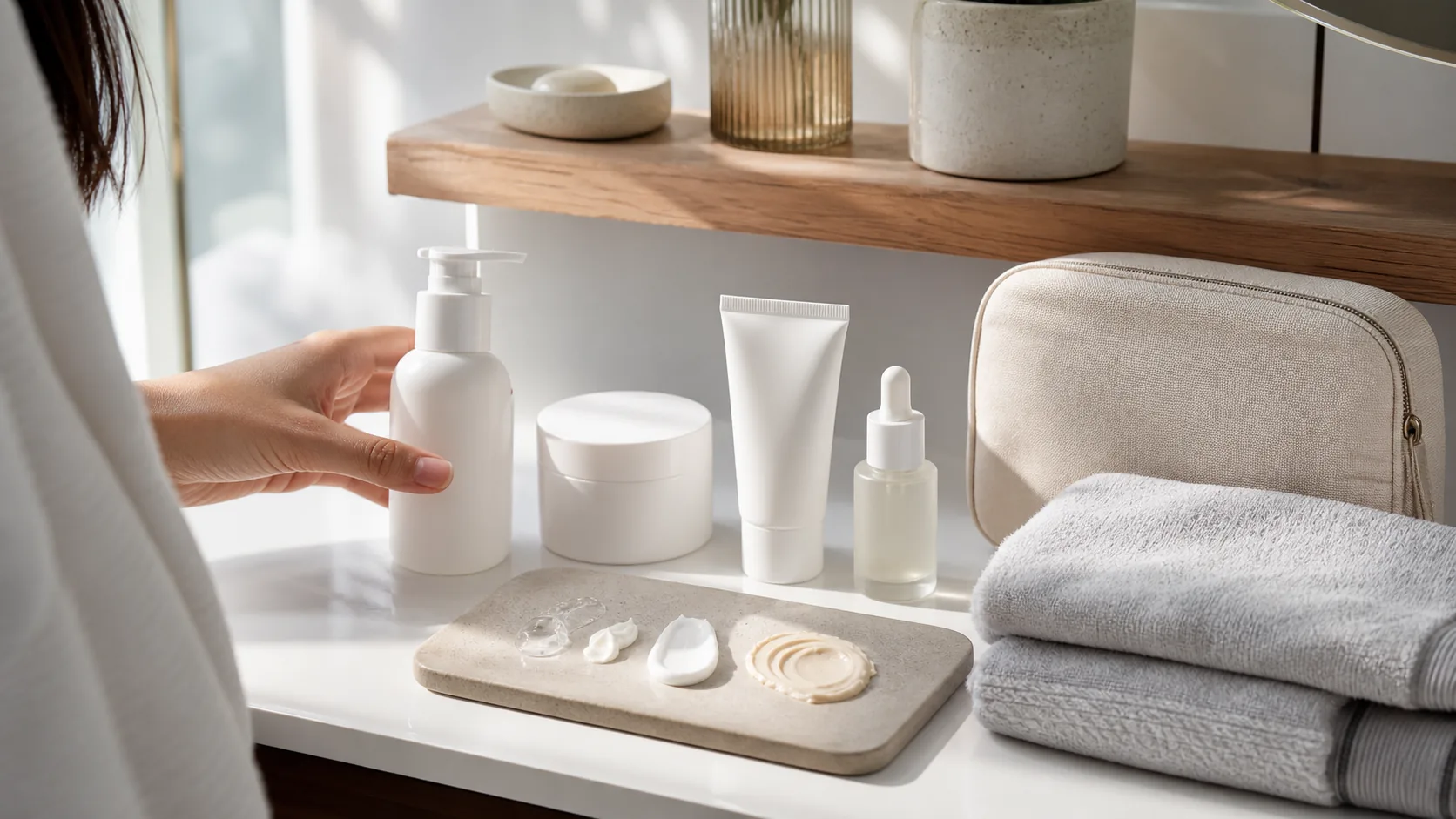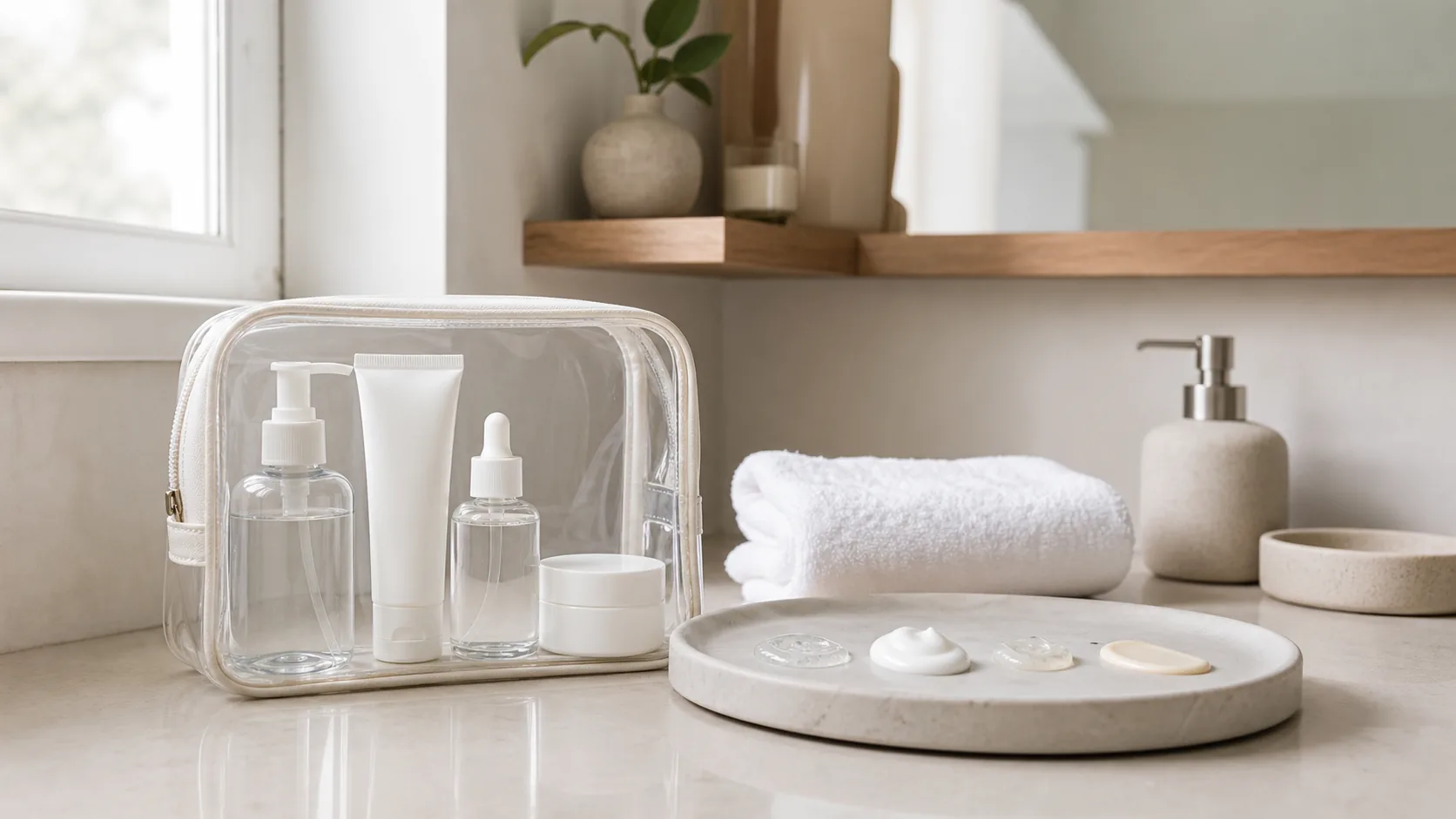
Build a travel skincare kit around four jobs: remove what needs removing, moisturize, protect from the sun, and continue any treatment that should not be interrupted. Everything else must justify the liquid-bag space for this particular trip.
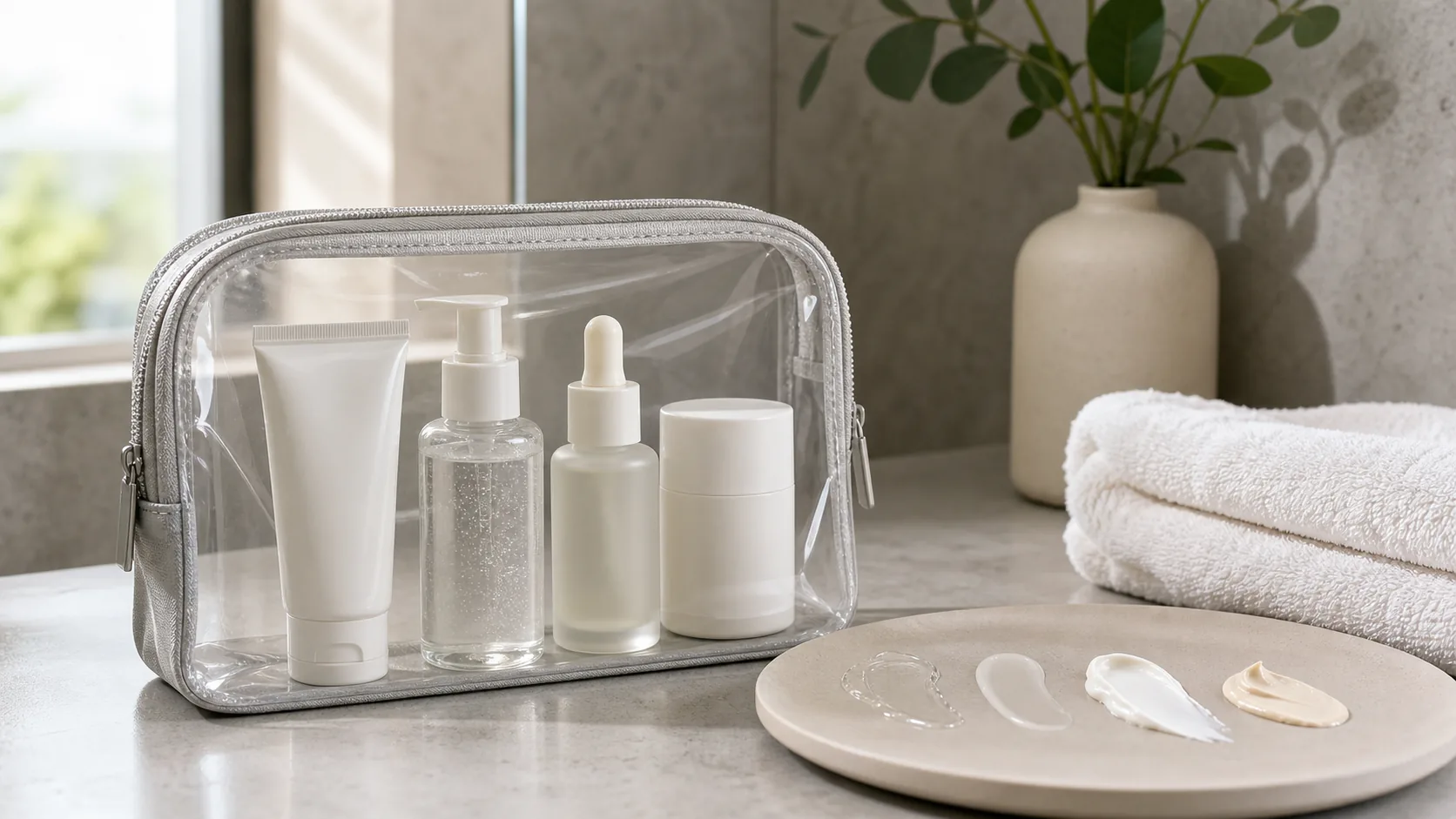
For US airport screening, liquids, gels, creams, pastes, and aerosols in a carry-on generally must be in containers no larger than 3.4 ounces or 100 milliliters, and they must fit in one quart-size bag. Medically necessary liquids and creams can follow a different screening process, so check the current TSA instructions before leaving (TSA travel tips).
That is a checkpoint rule, not a skincare shopping list. Start with the routine you already tolerate.
Read the trip before you read the shelf
Write down five facts:
- trip length;
- carry-on only or checked luggage;
- climate and expected sun exposure;
- activities such as swimming, hiking, makeup wear, or long outdoor days;
- prescription or OTC treatments that have label-dependent storage or schedules.
A two-night indoor trip and a two-week beach trip should not produce the same kit. The destination changes quantities and protection needs; it does not require an entirely new routine.
AAD travel guidance recommends keeping the travel routine similar to the routine used at home, which reduces uncertainty from unfamiliar formulas (AAD, travel skin-care tips). Hotel samples are not automatically gentler because they are small.
Give the clear bag four slots
Slot 1: cleanse or remove
Pack the smallest product system that removes your actual day.
- If you wear water-resistant sunscreen or makeup, bring a remover/cleanser combination that you already know works.
- If you use little product and tolerate one cleanser, do not create a two-cleanser ritual for travel.
- A cleansing bar that is genuinely solid may stay outside the liquids bag, but confirm current screening guidance and store it so it can dry.
The job is clean skin without a new irritation experiment.
Slot 2: moisturize
Bring one familiar moisturizer that works on the face and, when practical, other dry areas. Air travel and climate changes can make skin feel drier; the AAD advises moisturizing when skin feels dry and after bathing while skin is still damp.
If your usual moisturizer is too light for the destination, add a small, familiar occlusive for limited dry areas rather than replacing the entire routine with an untested rich cream.
Slot 3: protect
Sunscreen is an OTC drug in the United States, so keep its directions available. Choose the formula according to the exposure and use it as labeled. The AAD recommends broad-spectrum, water-resistant SPF 30 or higher for outdoor protection; FDA emphasizes following the product’s reapplication directions (AAD travel tips; FDA sunscreen guidance).
Do not save bag space by packing too little sunscreen for the planned outdoor use. If the needed amount will not fit, buy the same familiar product after security when feasible, use checked luggage, or adjust the packing plan—not the protective directions.
Slot 4: treatment
Bring prescription and OTC treatment only when you know how it fits the trip. Keep the pharmacy label or Drug Facts accessible. The label holds the warnings, directions, storage information, and expiration context that an anonymous travel pot cannot provide (FDA, OTC Drug Facts label).
If a treatment makes skin more sensitive to sun, heat, or irritation, ask the prescriber or pharmacist about the travel plan instead of inventing a vacation schedule.
What counts toward the TSA liquid limit
At a US checkpoint, skincare liquids, gels, creams, pastes, and aerosols generally count. The container capacity—not the amount left inside—is what matters. A half-empty 200 mL bottle is still a 200 mL container.
The standard carry-on rule is:
- 3.4 ounces / 100 mL or less per container;
- one quart-size bag;
- one liquids bag per passenger.
Rules can change, airports can require additional screening, and international departures may apply different requirements. Check the current TSA page and the rules for every airport on the itinerary rather than treating “3-1-1” as a worldwide promise.
Medically necessary liquids, medications, and creams may exceed the standard quantity when declared for screening. Do not hide a medical product in an unlabeled cosmetic jar to make the process look simpler.
Decant cosmetics without creating mystery products
For a familiar cosmetic, a clean travel container can reduce volume. Use these controls:
- start with a clean, dry container compatible with the product;
- add only one product;
- label it with the exact name and fill date;
- keep a photo of the original ingredient list and directions;
- close it tightly and protect it from damaging heat;
- discard it if identity, condition, or cleanliness becomes uncertain.
FDA notes that warm or damp storage and dirty containers can contribute to cosmetic deterioration or contamination (FDA, using cosmetics safely). Decanting does not create a new verified shelf life.
Avoid decanting prescription or OTC drugs when doing so separates the product from its required label. If the original package is too large for the plan, ask a pharmacist, prescriber, or manufacturer about an appropriate travel format.
Calculate quantity from use, not optimism
For cleanser and moisturizer, observe how much you actually use at home for several days, multiply by the number of travel days, and include a modest margin for delays or spills. This is a packing calculation, not a new dosing instruction.
For drugs and sunscreen, the label controls the amount and frequency. Work backward from those directions. If the resulting quantity exceeds the carry-on allowance, solve the baggage or purchasing problem rather than shrinking the labeled use.
Conditional additions must answer a trip-specific question
Bring an extra only when you can complete this sentence: “I need this because the trip includes ___.”
Reasonable examples include:
- lip balm for prolonged dry conditions;
- a familiar anti-chafing product for long walking days;
- a makeup remover when makeup is actually planned;
- a familiar acne treatment already established in the routine.
Leave behind:
- a new sample chosen only because it is travel size;
- several serums with overlapping jobs;
- strong peel products intended for a “vacation reset”;
- devices that require their own cleaning, charging, and troubleshooting without a clear need.
Use the arrival routine, not the arrival mood
On the first night, return to the familiar core. Travel fatigue, dry cabin air, a different climate, and a changed schedule already add variables. A new mask or peel makes any reaction harder to interpret.
If skin feels dry, use the familiar moisturizer more thoughtfully or add a known occlusive where needed. If a product causes a clear reaction, stop it and return to the last tolerable routine. Seek prompt help for a severe or rapidly worsening reaction.
One clear bag is enough when every item has a job and every drug keeps its instructions. The aim is not the smallest possible kit. It is the smallest kit that still performs the routine safely for the trip you are actually taking.
Common questions
Questions readers often ask
What should I know about read the trip before you read the shelf?
Write down five facts:
What should I know about give the clear bag four slots?
Pack the smallest product system that removes your actual day.
Sources
References used for this guide
- Transportation Security Administration: Travel tips and 3-1-1 liquids rule
- Transportation Security Administration: Travel checklist
- American Academy of Dermatology: Seven travel skin-care tips
- US Food and Drug Administration: The OTC Drug Facts label
- US Food and Drug Administration: Using cosmetics safely
- US Food and Drug Administration: Sunscreen guidance